
Articles on Genetics
Hundreds of articles on genetic research authored by professionals are available over the SD Blogs API.
Listing Article Summaries
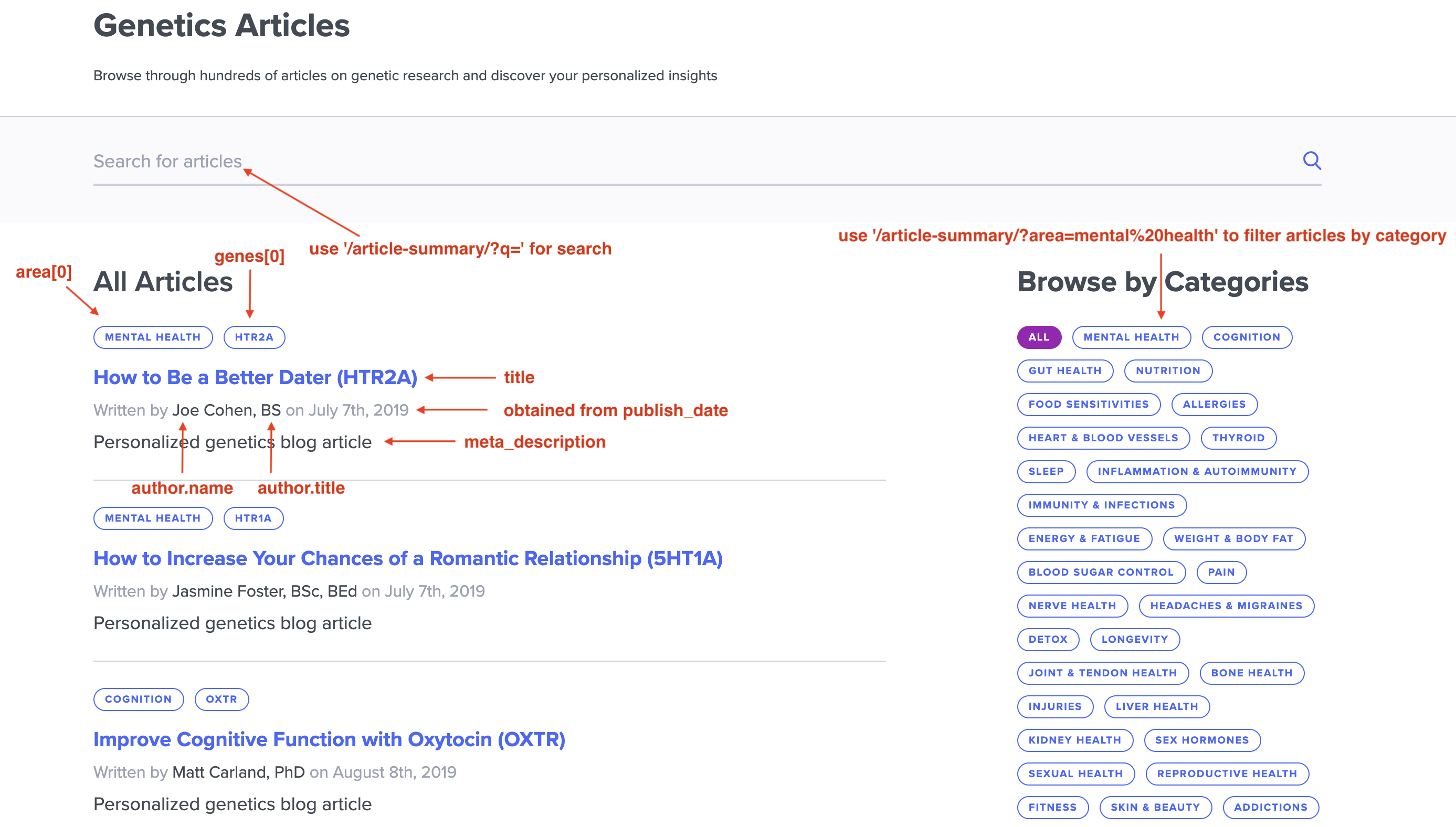
Use the GET /article-summary/ endpoint to list all available articles. The articles can be filtered and sorted by various query parameters. For more details regarding the available query params and the response structure, visit the endpoint.
Additionally, you can refer to the illustration below, which pinpoints how certain fields returned in the response can be used to construct an articles listing page UI.
Retrieving Article Details
To retrieve the complete details of a particular article, which includes the actual content, use the GET /article/{slug}/ endpoint.
Example Request
GET https://selfdecode.com/service/b2b-integrations/article/histamine-intolerance/
Example Response
{
"slug": "histamine-intolerance",
"title": "How to Combat Histamine Intolerance Through Genetics (DAO)",
"summary": "<p><strong>Do you get migraines or rashes after eating certain foods? Your genes affect how well two important enzymes clear histamine from your gut, skin, and brain. We’ll explore your genetic risk of intolerance and how to combat it.</strong></p>",
"meta_description": "Personalized genetics blog article",
"genes": [
"AOC1"
],
"area": [
"inflammation & autoimmunity"
],
"author": {
"id": 1,
"name": "Jasmine Foster",
"title": "BSc, BEd",
"intro": "<p><strong>Jasmine received her BS from McGill University and her BEd from Vancouver Island University.</strong></p>\r\n\r\n<p>Jasmine loves helping people understand their brains and bodies, a passion that grew out of her dual background in biology and education. From the chem lab to the classroom, everyone has the right to learn and make informed decisions about their health.</p>",
"photo": "https://selfdecode.com/cdn/media/health-analysis/blog/author-photo/Jasmine.jpg"
},
"publish_date": "2019-09-09T00:00:00Z",
"featured": false,
"recommendation_title": "Recommendations to Prevent or Manage Intolerance",
"content": [
{
"id": "1695",
"title": "What is Histamine Intolerance?",
"text": "<p>People with histamine intolerance have too much histamine: they either create it in excess or they can’t break it down quickly enough [<a href=\"https://www.ncbi.nlm.nih.gov/pubmed/17490952\">R</a>].</p>\r\n\r\n<p>As a result, when they eat foods that contain histamine, it crosses into their blood, and they experience inflammation; by contrast, a healthy person would break down most dietary histamine before it ever reaches the bloodstream [<a href=\"https://www.ncbi.nlm.nih.gov/pubmed/17490952\">R</a>, <a href=\"https://www.ncbi.nlm.nih.gov/pubmed/24286351\">R</a>].</p>\r\n\r\n<p>The most common culprit is low diamine oxidase (<a href=\"../../gene/aoc1/\">DAO</a>), the enzyme that breaks histamine down in the gut [<a href=\"https://www.ncbi.nlm.nih.gov/pubmed/17490952\">R</a>].</p>\r\n\r\n<h3>Allergy-Like Symptoms</h3>\r\n\r\n<p>Histamine intolerance mimics an allergic reaction. Symptoms may include diarrhea, headaches, stuffy and runny nose, eye redness, asthma, low blood pressure, arrhythmia, hives, itching, and flushing [<a href=\"http://onlinelibrary.wiley.com/doi/10.1111/all.12330/full\">R</a>].</p>\r\n\r\n<p>People with less efficient DAO are more likely to suffer from migraine headaches as well. According to one study, those with the ‘T’ allele at rs10156191 or rs2052129 (or both) are at a significantly higher risk of developing migraines [<a href=\"https://headachejournal.onlinelibrary.wiley.com/doi/abs/10.1111/head.12493\">R</a>].</p>\r\n\r\n<h3>How Can You Tell If You’re Intolerant?</h3>\r\n\r\n<p> </p>\r\n\r\n<p>Approximately 1% of the population has histamine intolerance. In contrast to food allergies, in which even a small amount of the allergen causes a reaction, the cumulative amount of histamine is crucial to inducing a reaction [<a href=\"https://www.ncbi.nlm.nih.gov/pubmed/17490952\">R</a>].</p>\r\n\r\n<p>Although 75 mg of liquid histamine can provoke symptoms in healthy volunteers, defining the safe threshold level in sensitive individuals is difficult. Canned sardines, which are very likely to trigger symptoms in intolerant people, have as much as 20 mg per 100 g, but some people react to foods that contain much less [<a href=\"https://www.ncbi.nlm.nih.gov/pmc/articles/PMC4604636/#CR71\">R</a>, <a href=\"https://www.ncbi.nlm.nih.gov/pmc/articles/PMC4604636/#CR72\">R</a>, <a href=\"https://www.ncbi.nlm.nih.gov/pubmed/1470866\">R</a>, <a href=\"https://www.ncbi.nlm.nih.gov/pubmed/17490952\">R</a>].</p>\r\n\r\n<p>If you think you may be intolerant, monitor yourself for allergy-like symptoms after you consume a high-histamine food such as canned sardines.</p>\r\n\r\n<p><span style=\"background-color:#e8ebfc\">Histamine intolerance, which is most often caused by deficient or defective DAO enzymes, causes allergy-like symptoms including headaches, rashes, and a stuffy nose.</span></p>\r\n\r\n<h3>Why is AOC1 (DAO) Important?</h3>\r\n\r\n<p>AOC1 (or DAO) codes for diamine oxidase, one of the major enzymes that breaks down histamine. DAO is mostly found in the gut, though it’s also in the kidneys and connective tissues [<a href=\"https://www.ncbi.nlm.nih.gov/pubmed/24286351\">R</a>, <a href=\"https://www.ncbi.nlm.nih.gov/pmc/articles/PMC6129797/\">R</a>].</p>\r\n\r\n<p>Because of its location in the gut, this enzyme is our primary defense against histamine and histamine-producing bacteria in our food. Unsurprisingly, DAO deficiency is the primary cause of histamine intolerance [<a href=\"https://academic.oup.com/ajcn/article/85/5/1185/4633007\">R</a>].</p>\r\n\r\n<p><span style=\"background-color:#e8ebfc\">DAO is the major histamine-degrading enzyme in the gut. It is our primary defense against histamine produced by bacteria in our food.</span></p>",
"snps": []
},
{
"id": "1696",
"title": "Your Histamine Gene Results for Intolerance Risk",
"text": "<p> </p>\r\n\r\n<h3>Important SNPs</h3>\r\n\r\n<p><strong>AOC1 rs10156191:</strong></p>\r\n\r\n<ul>\r\n\t<li>‘C’ = Normal production of diamine oxidase (DAO)</li>\r\n\t<li>‘T’ = Reduced production of DAO, increased risk of histamine intolerance</li>\r\n</ul>\r\n\r\n<p><strong>AOC1 rs2052129:</strong></p>\r\n\r\n<ul>\r\n\t<li>‘G’ = Normal production of DAO</li>\r\n\t<li>‘T’ = Reduced production of DAO, increased risk of histamine intolerance</li>\r\n</ul>\r\n\r\n<p><strong>AOC1 rs1049742:</strong></p>\r\n\r\n<ul>\r\n\t<li>‘C’ = Normal production of DAO</li>\r\n\t<li>‘T’ = Reduced production of DAO, increased risk of histamine intolerance</li>\r\n</ul>\r\n\r\n<p><strong>AOC1 rs1049793:</strong></p>\r\n\r\n<ul>\r\n\t<li>‘C’ = Normal DAO enzyme activity</li>\r\n\t<li>‘G’ = Reduced DAO enzyme activity, increased risk of histamine intolerance</li>\r\n</ul>\r\n\r\n<p>{snp-table}</p>\r\n\r\n<p> </p>",
"snps": [
"rs10156191",
"rs2052129",
"rs1049742",
"rs1049793"
]
},
{
"id": "1697",
"title": "How Does Defective DAO Cause Problems?",
"text": "<p>Defective or deficient DAO is the leading cause of histamine intolerance. Any one of several variations (as shown in the table above) can slow down your DAO enzyme; the more bad variants you have, the more likely you are to be intolerant [<a href=\"https://www.ncbi.nlm.nih.gov/pubmed/21488903\">R</a>, <a href=\"https://headachejournal.onlinelibrary.wiley.com/doi/abs/10.1111/head.12493\">R</a>, <a href=\"https://www.ncbi.nlm.nih.gov/pmc/articles/PMC3495953/\">R</a>].</p>\r\n\r\n<p> </p>",
"snps": []
}
],
"recommendations": [
{
"id": 1318,
"title": "To Prevent Histamine Release",
"text": "<p>Most of the strategies for managing histamine intolerance prevent histamine from being either produced (histidine decarboxylase inhibitors) or released (mast cell stabilizers). Over on SelfHacked, we’ve compiled a comprehensive list of supplements and lifestyle options that can help; <a href=\"https://selfhacked.com/blog/natural-antihistamines/\">check out this post to see them all</a>.</p>\r\n\r\n<p>It’s also a good idea to reduce the amount of histamine you consume in your food. <a href=\"https://selfhacked.com/blog/low-histamine-diet/\">This post</a> explains how to make the most of a low-histamine diet. For a dive into which foods are high and low in histamine, <a href=\"https://selfhacked.com/blog/foods-high-low-in-histamine/\">check out this post</a>.</p>"
},
{
"id": 1319,
"title": "To Increase DAO Activity",
"text": "<h4>Diet</h4>\r\n\r\n<p><em>Lathyrus sativus</em> (white pea or grass pea) is a tropical legume that naturally contains DAO. However, it also contains a neurotoxin that can be dangerous if the peas are not properly prepared. If you choose to eat white peas, make sure to closely follow cooking instructions to eliminate the threat [<a href=\"https://www.ncbi.nlm.nih.gov/pmc/articles/PMC5486577/\">R</a>, <a href=\"https://www.ncbi.nlm.nih.gov/pubmed/16332380\">R</a>].</p>\r\n\r\n<p>DAO requires vitamin C, vitamin B6, and copper to function normally. Make sure you get enough of these nutrients in your diet [<a href=\"https://academic.oup.com/ajcn/article/85/5/1185/4633007\">R</a>].</p>\r\n\r\n<p>The omega-3 fatty acids <a href=\"https://selfhacked.com/blog/fish-oil-top-22-science-based-health-benefits-of-fish-oil/\">DHA and EPA</a> appear to encourage the release of DAO in the gut. These healthy fats are generally anti-inflammatory, so it’s a good idea to increase your intake [<a href=\"https://www.ncbi.nlm.nih.gov/pubmed/9756524\">R</a>, <a href=\"https://www.ncbi.nlm.nih.gov/pmc/articles/PMC2956412/\">R</a>].</p>\r\n\r\n<h4>Supplements</h4>\r\n\r\n<p>The simplest solution for reduced DAO activity is also the easiest: diamine oxidase is available as a supplement. DAO supplements reduce or eliminate headaches in people with confirmed enzyme deficiency [<a href=\"https://www.ncbi.nlm.nih.gov/pubmed/29475774\">R</a>].</p>\r\n\r\n<p>You can also get DHA and EPA as a supplement by taking fish oil [<a href=\"https://ods.od.nih.gov/factsheets/Omega3FattyAcids-Consumer/\">R</a>].</p>\r\n\r\n<h4>Drugs</h4>\r\n\r\n<p>Diphenhydramine (the active ingredient in Benadryl) blocks histamine from binding to the H1R receptor, but it may also increase DAO activity. In one cell study, diphenhydramine enhanced DAO by 19% at the highest studied concentration. Note, however, that this effect has not yet been observed in animals or humans [<a href=\"https://www.ncbi.nlm.nih.gov/pubmed/9831324\">R</a>].</p>"
}
],
"related_reports": [
"7826b78a-0a7a-4b75-aede-455b6494e2f8",
"39bcfe8b-4656-4bff-80f2-d15c70c8994d",
"1d7f0c6f-50c4-47f7-8169-dcca0d83a291",
"3bfeb7ac-5a29-466a-b578-621d53e7a580",
"77ee420f-0942-40a8-a10f-770e5567ff2f",
"abb16414-f7ce-45fa-aef4-81417e7d77b7",
"c1883775-fe5b-40ba-806e-09302ea36a99",
"9ca2a28c-df42-4d8f-b7cc-7b2137e3b70f",
"0f464c5e-490f-4c19-833e-a31f89f9344c",
"1443b01c-6b99-4d09-ab12-bf8f236e0677",
"8f85d492-1501-4b74-a251-b625cb1c6d58",
"f9690ff5-7756-4397-b8eb-6d172389a68e",
"b0bfced7-ecfc-43b8-9a1a-8b0e22845b19",
"1552dfdc-6746-4da3-acce-f7bd81e8dc3a",
"884e9f0f-377a-4fa2-a195-a3d2a4bdfa4b",
"77279d0e-0a99-464b-98dd-45793bb596ed",
"9bf9de18-d93e-48fc-92bd-e8917b9342d9"
]
}
Illustration
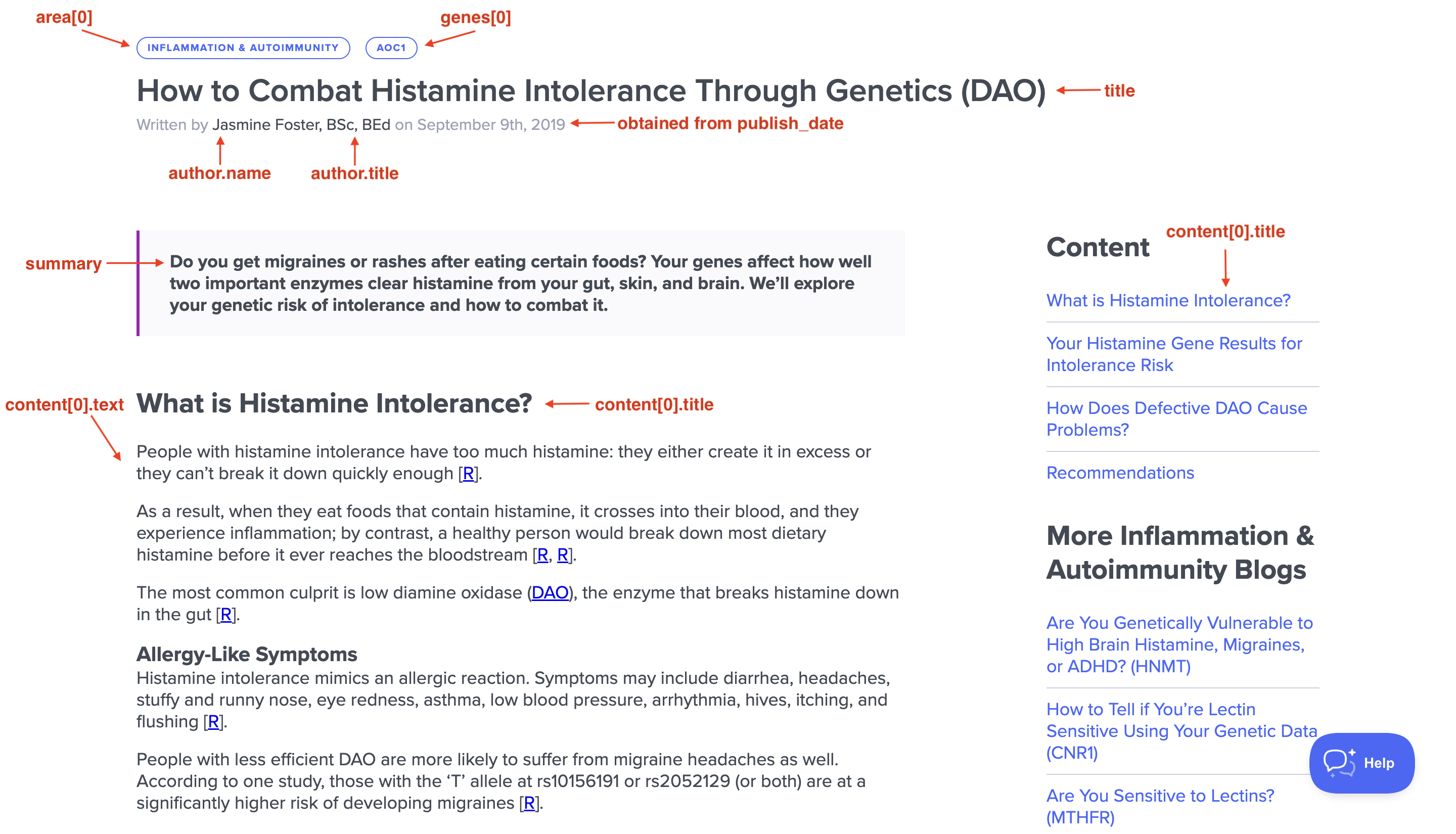
The illustrations below show how an article detail page UI can be made using fields returned from the endpoint.
Article Intro & Content
Each article can have multiple sections for the main content, available under content which is a list, where each list item represents an article section.
Article Main Content & Intro
Article Content Including SNPs
To follow along and understand what SNPs mean, you can refer to Understanding Genetics.
Some article sections contain extra information, in the field content[n]["snps"] which contains a list of SNPs (rsIDs) associated with the article. If you refer back to the example response above, you can see that in the content[1]["snps"] field. You can use these SNPs to construct a SNP table as shown below.
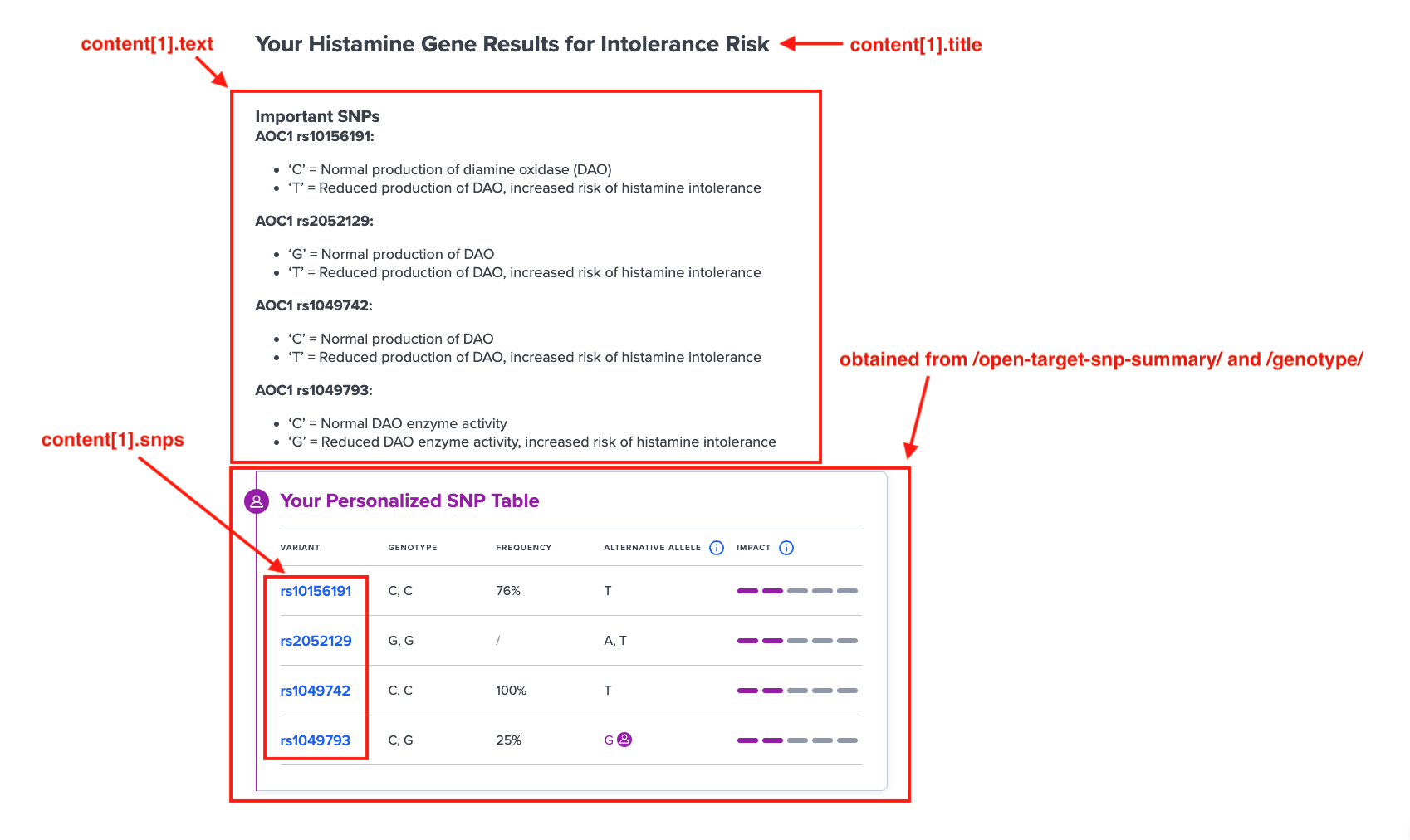
Article Section with SNP Table
To do so, you would need to query the /open-target-snp-summary/ endpoint, having query params:
gene_slug=genes[0]which would begene_slug=A0C1for this examplersid=<comma separated content[n]["snps"]>which would bersid=rs10156191,rs2052129,rs1049742,rs1049793for this example
and you would also need to query the /genotype/ endpoint, including query param:
rsid=<comma separated content[n]["snps"]>which would bersid=rs10156191,rs2052129,rs1049742,rs1049793for this example- for rest of the required query params refer to the endpoint
Refer here for more details about the above two endpoints and see the illustration here to understand how a SNP table can be constructed using fields returned from the above two endpoints.
Rare Case with SNP Based Articles
Although, currently almost all articles available over the API have only a single gene tied to them, i.e. you get only one entry in the genes field, but there can be an exception to this rule; for example, for the article with slug il6-weight, you get two genes in the response:
"genes": [ "IL6", "IL6R" ]
For such an article, if you need to fetch the SNP table, you would make two calls to the /open-target-snp-summary/ endpoint, as it only supports one gene at a time:
Call 1: /open-target-snp-summary/?gene_slug=IL6&rsids=rs1800795,rs10242595,rs2229238,rs4845623,rs2228145
Call 2: /open-target-snp-summary/?gene_slug=IL6R&rsids=rs1800795,rs10242595,rs2229238,rs4845623,rs2228145
And you would combine the results of the two calls to get the final SNP table.
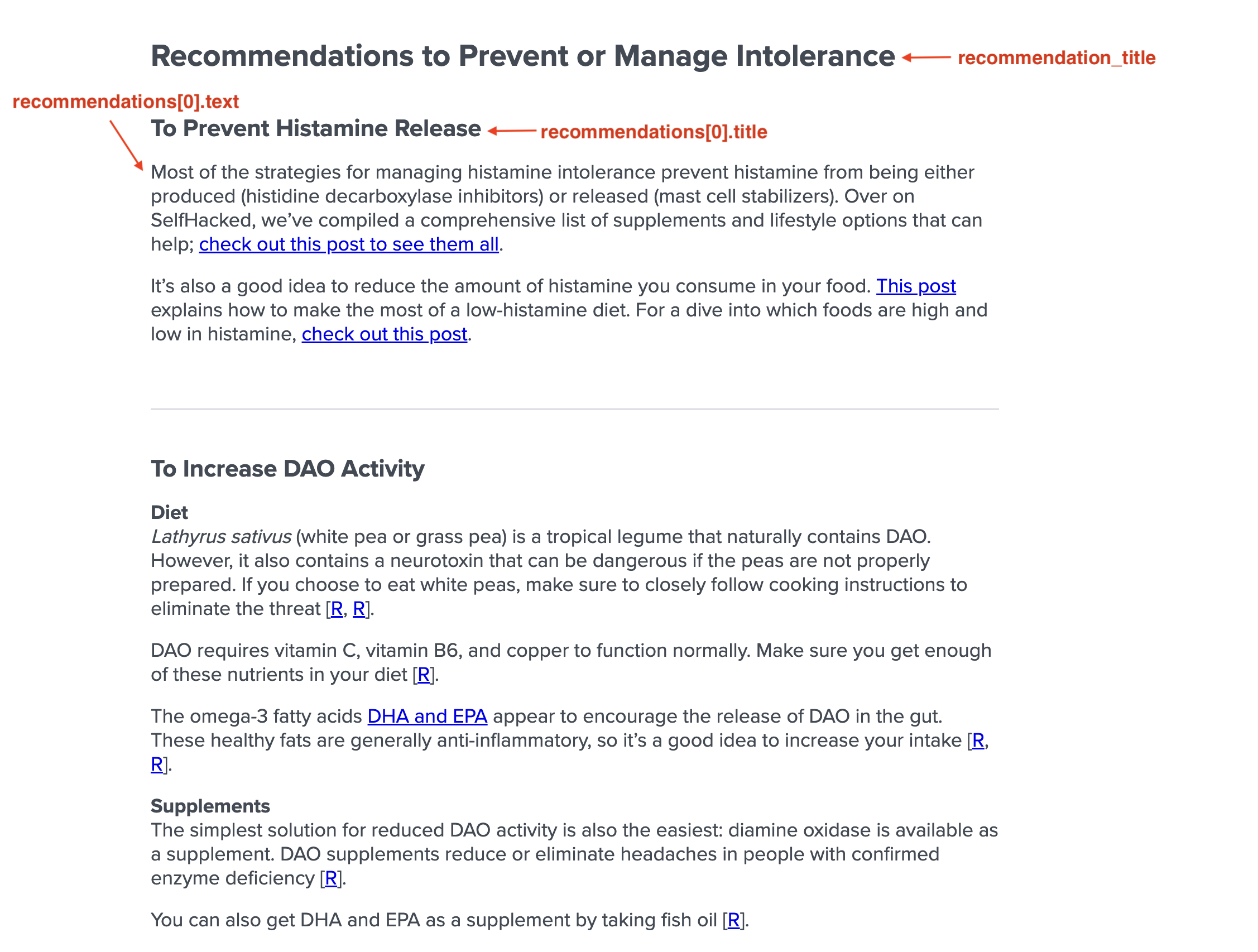
Article Recommendations
Often, multiple recommendations are tied to an article, available under the recommendations field.
Article Recommendations
Article Author
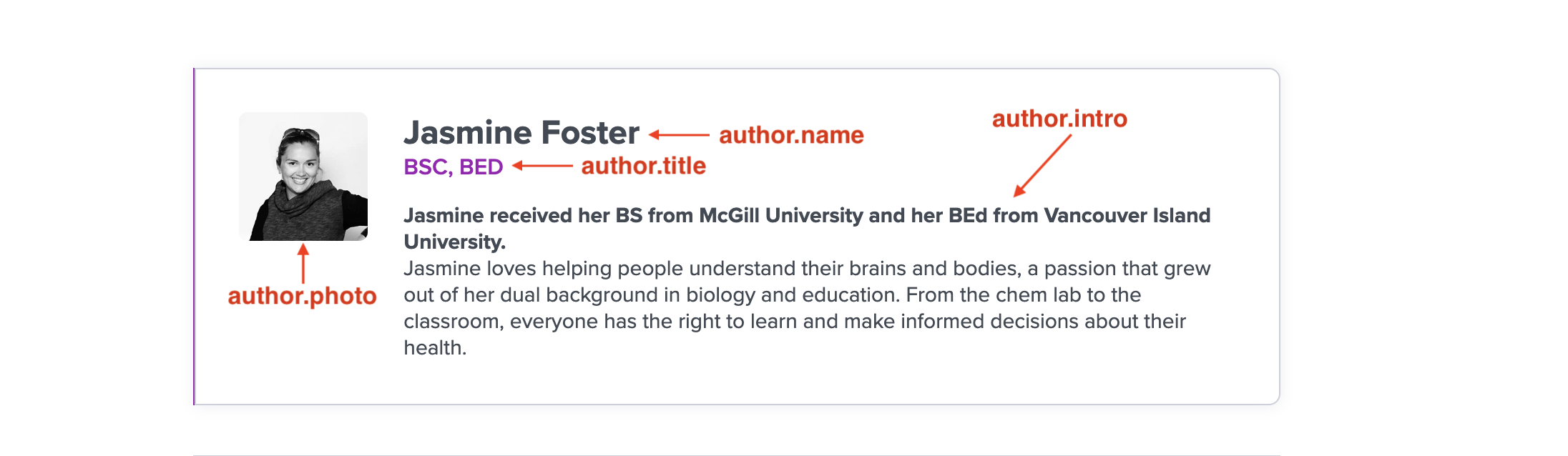
Article Author Details